
I was a witness.
I was there when the Buddhist monks walked through Greensboro, North Carolina on their way to the Grandover Resort & Spa where they were taking their night’s refuge [sleeping on the floor; not in any of the luxury rooms available there] and where lead walker, Venerable Pannakara (Sư Tuệ Nhân), would deliver his evening talk.
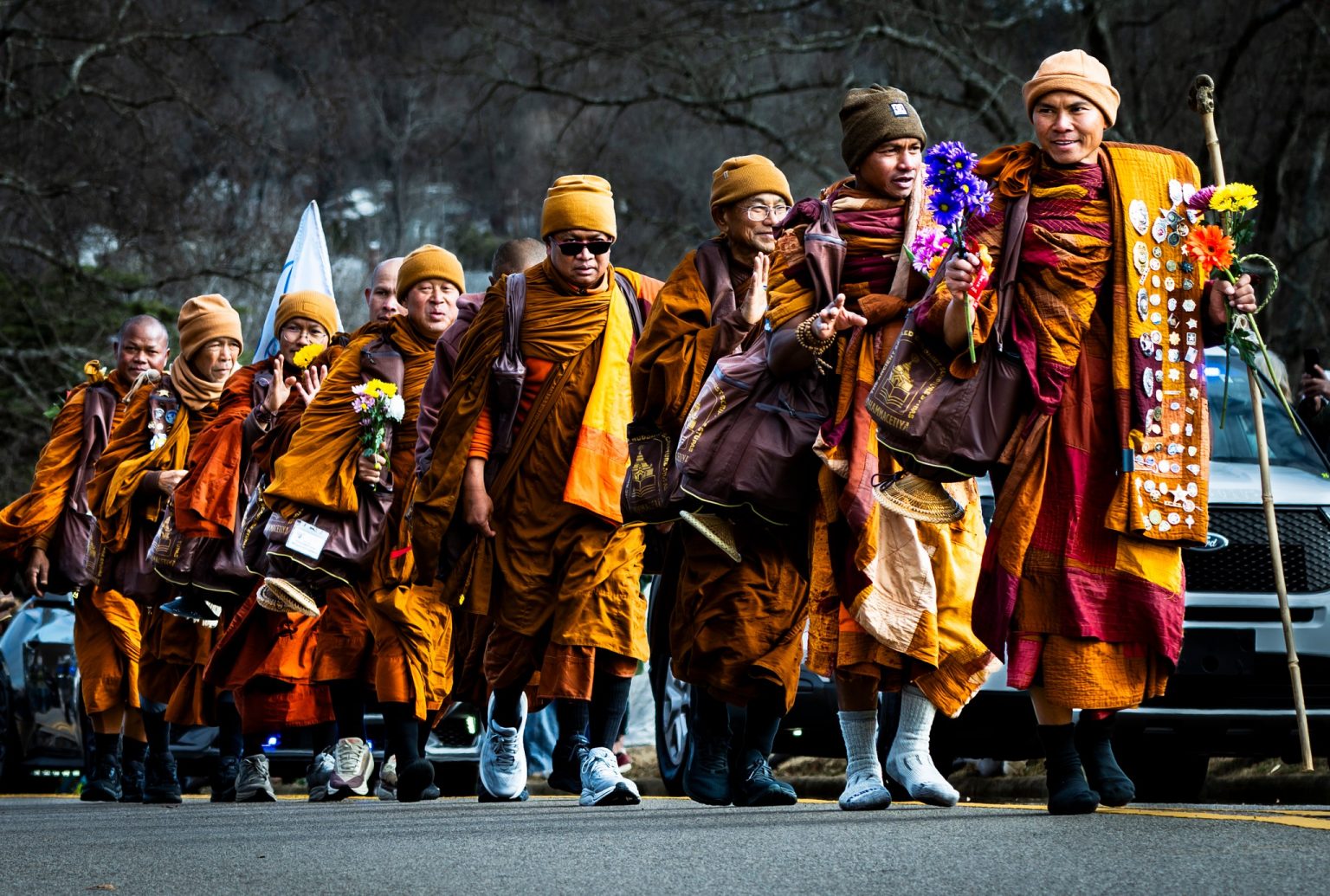
Outside was crowded with folks: Black ones, brown ones, white ones, young and old ones—of all social classes, from varied religious affiliations, and of differing educational statuses. We were all there as one body—waiting to see, to hear, to be touched by [some needing to be awakened with] this spiritual movement led by brown Buddhist monks who don’t believe in God but believe, ardently so, in people. Our walking for peace will not miraculously blanket this country with peace, said 44-year-old Venerable Pannakara. [I’m paraphrasing.] Instead, we hope our mindful walking will awaken viewers to their own light, and each person we encounter—from Ft. Worth Texas to Washington, D.C.—who is enlightened by our movement, contributes to a more humane collective; eventually, like individual fireflies that gather, together we will light up this dark country.
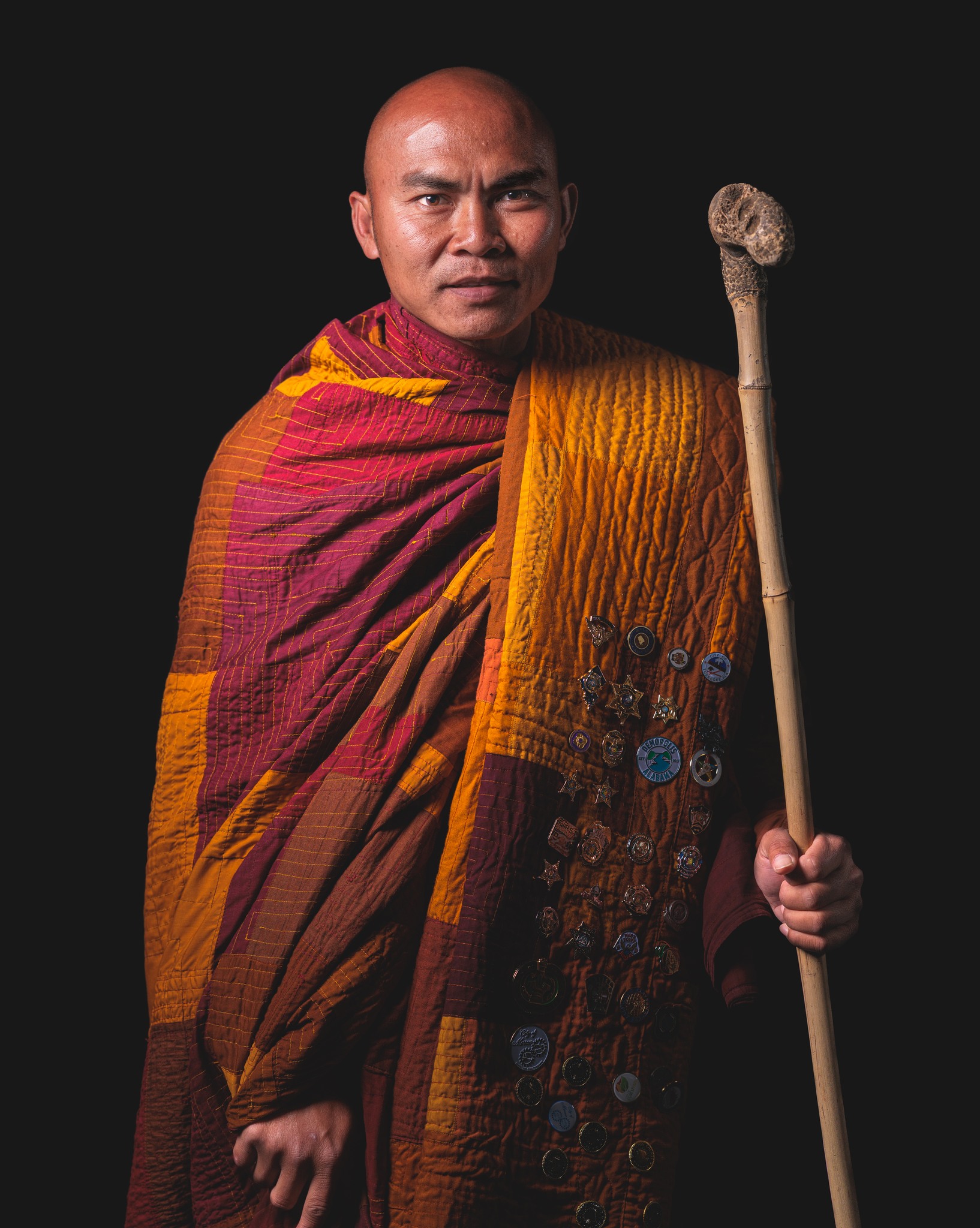
Brother Pannakara, a humorist, spoke to a standing congregation about mindfulness practices. He taught us how to breathe, to be still, to feel our hearts. He talked about suffering and the relationship it has with consumerism and expectation. He explained the monkey mind concept that distracts us from focusing our attention. And he encouraged us to put down our “lovers,” the cell phones we give our attention to, thus resulting in our forfeiture of the present moment—wherein, claimed Vietnamese monk Thích Nhất Hạnh, freedom exists. Undoubtedly, Venerable Pannakara gave us a lot to contemplate—and for folks who aren’t knowledgeable of or haven’t studied Buddhist practices, Pannakara’s talk probably felt simple. Too simple. So simple, we don’t get it. Unusually simple, it’s trivialized, thus necessitating the monks’ 2,300-mile pilgrimage from Ft. Worth, TX to Washington, DC during the dead of winter, iced in current political leadership.
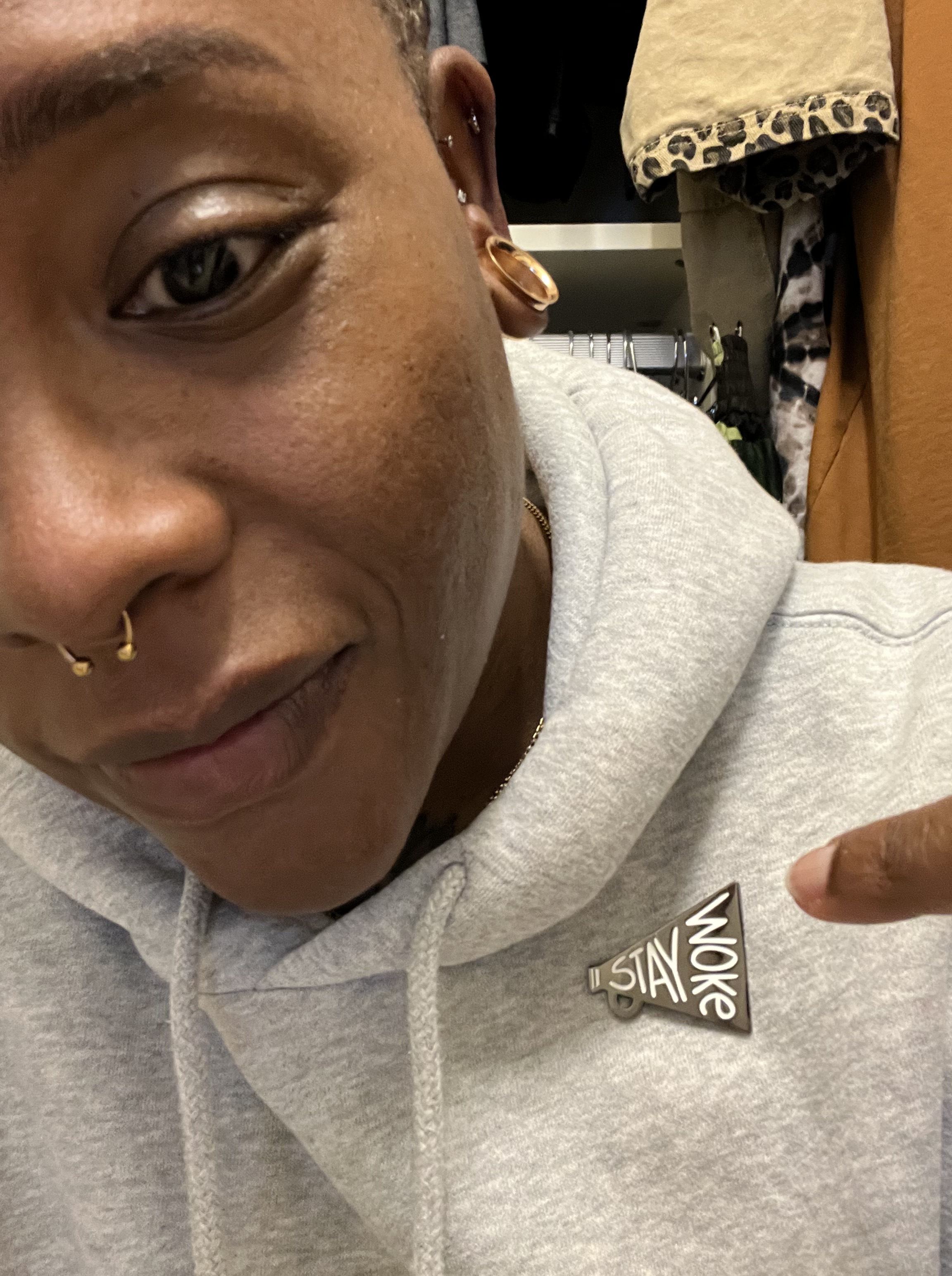
I witnessed the walking-for-peace Monks that Monday—the Monday the country observes Martin Luther King and his nonviolent contributions to America’s civil rights. I felt honored, and Black, and activist. I had on my Stay Woke lapel pin, coupled with my “I Have a Dream” button. I had on my hoodie sweatshirt. I had on all the attitudes and desires of a movement. The moment was serendipitous: The Buddhist monks who were walking to raise “awareness of peace, lovingkindness, and compassion across America and the world” was in Greensboro, NC—home of the 1960 Greensboro Four and the Woolworth Counter Sit-Ins; home of the 1969 Dudley High and North Carolina A&T uprising; home of the 1979 Greensboro Massacre—on Martin Luther King Day. Black people’s holyday.
I couldn’t wait to hear the Monks’ talk—to hear what I imagined would be akin to a King speech amid a movement meant to dramatize America’s shameful condition. Alas, the only thing that was dramatized was my expectation and absolute disappointment. No one mentioned King. Not one body. And that omission angered me because not only do I believe the African proverb: “Ancestors never die until there is no one to call their names,” but during his opening words—where he should have acknowledged Martin Luther King—Venerable Pannakara, instead, took too much time acknowledging law enforcement. He took too much time thanking them for their support. And he gave too much attention to the lapel pins state police officers gifted him.
These badges pinned to his orange kasaya are nothing more than baseless peace offerings trending from state to state as quickly as Black Codes at the brink of Reconstruction. And Pannakara adorns himself in these visible symbols of state sanctioned violence, which feels absurd. It’s all a bit unsettling. And it illustrates how a narrative gets flipped and/or a people misconstrued, how po-lice violence goes unchecked—even by peace leaders.
The po-lice, as an organization, is antithetical to Buddhism. The very act of a po-lice department figure pinning a Buddhist monk is oxymoronic. Surely, in a utopian world, this brotherly act could be a beautiful expression of a country whose law and order is committing to peace and justice, except that it ain’t. As a matter of fact, if the Buddhist monks had not pre-identified themselves, if you will, as they are, the very same po-lice that have been commissioned to aid their travels would more than likely, in one state or another, have apprehended them for trespassing, or for walking barefoot in public, or for not having a dog on its leash, or for gathering in groups, or for appearing flagrant, houseless, and bedraggled, or for simply walking as brown men—who, with their walking sticks, risked being killed by the same po-lice force who, unmistakably, would have mistaken their walking sticks for clubs or shot guns or spears or machetes or lasers or [name a po-lice misidentified weapon].
IJS.
The Venerable Pannakara missed his moment to genuinely acknowledge the po-lice and hold them accountable for the perpetual suffering they impose on the people. Couldn’t Pannakara hold law enforcers in gratitude and responsibility? Couldn’t he, as James Baldwin argued, seriously criticized this country because he loves it? While I understand the monks are moving with and in lovingkindness and compassion toward peace, this country can only be united under reconciliation, and that is contingent upon a whole truth.
I mean, really: If a Buddhist monk leading a nationwide movement that has garnered millions of social media followers, in addition to the many people who pour into the physical streets to witness them, wears a sheriff’s badge—wears sheriff badges—how should the people receive his message?
Shrugs. I’m skeptical. [But I usually am about many things, and these days, about most people, too.]
__
Hit that like button, leave me a comment, and follow me for more of my two cents.
 Dr. Kendra N. Bryant Aya | s/her