

For the past year or so, I’ve been working on a poetry chapbook re: my childhood experiences as I remember them. I was born in 1979—the same year Arthur McDuffie was murdered by police, which incited a 3-day riot in the Liberty City and Overtown areas where my mom and dad lived as children (where Cassius Clay lived, Sidney Poitier was born, and the historical Hampton House harbored Martin Luther King, Malcolm X, and Josephine Baker, to name a few). That same year, too many Black children were murdered in Atlanta; 11 Black women were murdered in Boston; and five communist workers were murdered by the Ku Klux Klan in Greensboro, NC, where I currently live. However, I grew up in Miami Gardens, Florida during the 80s and 90s when 2 Live Crew was being banned in the USA and C. Delores Tucker was warring against gangsta rap—the very sound influenced by blues and Black Arts Movement poetry expressing how we got ovuh. No doubt: the music, magazine, and film scene of that era, coupled with 20th century poetry, were my curricular matter for the organic lessons I received re: America’s Black history, which informed? maybe instigated? my lukewarm patriotism for this country.
As a middle schooler, I use to write poems about being enslaved, about being disenfranchised, about being a panther in “ameriKKKa.” During that time, I was engrossed in Maya Angelou’s autobiographical series and became acquainted with the Black Panther Party. By the time I got to high school, I was wearing my daddy’s Black History Month dashikis and penpalling with Ruchell “Cinque” Magee, the longest-held political prisoner in the United States, who was in the courtroom shootout that brought notoriety to Angela Davis. My Daddy told me I was a revolutionary with no cause, which I shrugged off cause I believed I was on the course toward one—still am.
Anyway, from Jet to Word Up! magazine, Queen Latifah and Public Enemy, Shirley Caesar, Spike Lee, Maya Angelou and Nikki Giovanni, I was wrapped in rainbows all the time. But I didn’t understand the gravity of Black folk existence and struggle, which I reckon is what my daddy was tryin to say. No matter how much I knew via my media intake as well as my lil lived experiences through majority white schools and integrated neighborhoods where our next door neighbors were white folks with whom my parents exchanged Christmas gifts, all I really knew, my daddy was sayin, was that I knew nothin at all, particularly about the Black American struggle.
⊙
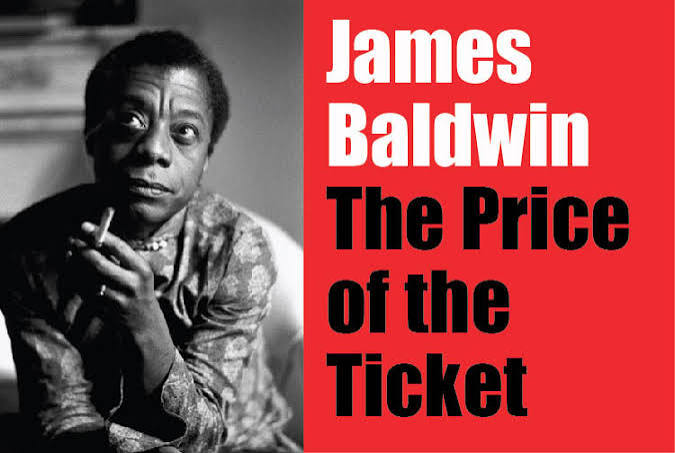
I’ve been reading James Baldwin’s The Price of the Ticket (Beacon Press, 1985) for the past two years. Inarguably, he is the 20th century’s definitive critic of America. As a matter of fact, Baldwin’s critiques are timeless, for much of what he said between 1948 (when my mother was born) and 1985 is apropos to this century’s climate, and I imagine, will be just as relevant to and in our Black future. This week, I’m reading The Devil Finds Work (The Dial Press, 1976), and in its initial pages, Baldwin is critiquing (or reviewing) cinema, while largely (and always) assessing white America’s behaviors and attitudes re: its Black, Brown, and non-Christian populace. In his review of Charles Dickens’s A Tale of Two Cities (1859), which had been made into a “screen rendition,” Baldwin reflects on two parts of the film/book that troubles him—particularly how Dickens writes about the oppressed and impoverished. Basically, while dying, a peasant boy recalls his father telling him that bringing children into a world of poverty is dreadful, “and that what we should most pray for was that our women might be barren and our miserable race die out!” According to Dr. Alexandre Manette, a central character in Dickens’s work, writes Baldwin, “‘I had never before seen the sense of being oppressed bursting forth like a fire,’” to which Baldwin frankly retorts: “Dickens has not seen it at all.” Baldwin most notably goes on to write:
“The wretched of the earth do not decide to become extinct, they resolve, on the contrary, to multiply: life is their only weapon against life, life is all that they have. . . . There is a ‘sanctity’ involved with bringing a child into this world . . . Dreadful indeed it is to see a starving child, but the answer is not to prevent the child’s arrival but to restructure the world so that the child can live in it.”
Today, America is 250 years old, and I am 46—a Black queer woman as free as I can be in a country founded upon the liberatory guarantee of white “Christian” men whose power hinges upon disenfranchising everybody else. But my God, Black people! my kinfolk! have insisted on living and using their life, says Baldwin, to counter every attempt on their existence. But like a tree that’s planted by the waters:
“Still, I rise,” wrote Maya Angelou.
“Fight the power,” rapped Public Enemy.
“I am the greatest!” proclaimed Muhammad Ali.
“I am somebody,” said Jesse Jackson.
“Up! Up! You mighty race,” roared Marcus Garvey.
“Change the things you cannot accept,” advised Angela Davis.
“Keep your eyes on the prize,” says my momma, borrowing from 1960s civil rights movement song and rhetoric.
We really are here because they were—because our ancestors and elders chose and choose to live and to be alive in the world. That alone is revolutionary and, says Baldwin, “Beneath the resonance of the word, revolution, thunder[s] the word, revenge.” And lowkey, ain’t that what we been doin every time we choose to live, survive, and thrive inside an imperialist white supremacist capitalist patriarchal white America whose 1776 revolution freed itself from Great Britain, while objectifying its Black citizens to and for whatever? Revenging.
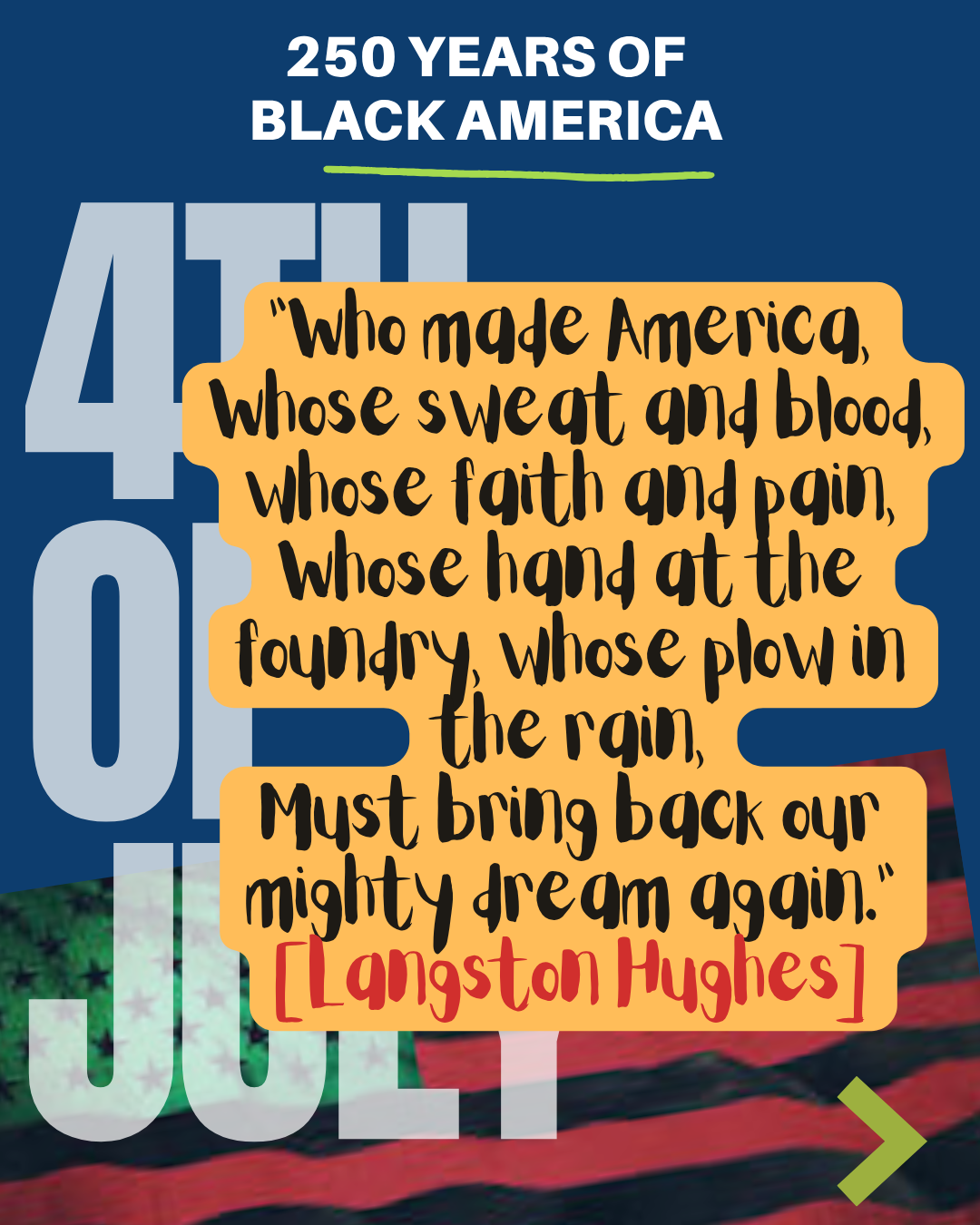
Every day, for the last 250 years, that we have said yes! to living, we are saying yes! to a Black life unexpected—to revenge ourselves and, writes Langston Hughes, “make America again!”


The Architecture of Black Survival to ensure that America will be!!!
Dr. Bryant Aya recently reminded us that on America’s 250th birthday the greatest act of revolution remains the refusal of the Black body to become extinct. Quoting James Baldwin, “The wretched of the earth do not decide to become extinct, they resolve, on the contrary, to multiply” Our ancestors calls us to witness a stubborn, life-affirming resistance to ensure that America will be!!!
In this spirit I want to name the ghost that haunts our celebration: Crispus Attucks. When he fell at the Boston Massacre, he was the first to bleed for a conception of liberty that did not yet include him. His sacrifice is not a simple footnote; it is a profound irony, he died for a nation that would, for generations, treat his kin as property to ensure that America will be!!!
Frederick Douglass gave voice to that irony in 1852 when he asked, “What, to the American slave, is your Fourth of July?” That question is more than indictment; it is an autopsy on the national conscience. Douglass showed us how the “buds and blossoms” of Black desire were repeatedly pruned by a state that too often regarded Black life as commodity rather than human life to ensure that America will be!!!
James Baldwin deepened the critique by stating the “price of the ticket” into the American Dream has too often demanded the forfeiture of soul. Baldwin understood that the struggle was not only against unjust laws but against an internalized despair that corrodes possibility. His insistence that we must not choose extinction but instead restructure the world is both diagnosis and call to action to ensure that America will be!!!
If we ask where to find the fortitude for such restructuring, there is a strange companion in Marcus Aurelius’ Meditations: “The best revenge is to be unlike him who performed the injury.” Filtered through Black life, that stoic counsel refuses mimicry of brutality and offers instead a moral architecture for survival. Our revenge is not retaliation; our revenge is our becoming to ensure that America will be!!!
That becoming looks like multiplication of families and futures, of communal wealth and shared knowledge, of intellectual and entrepreneurial life both formal and informal. It is Angelou’s “still I rise,” Mary Church Terrell’s “lifting as we climb,” and a collective insistence on flourishing where flourishing was denied to ensure that America will be!!!
We are the Black life unexpected the living proof that the 1776 revolution was incomplete and that the real revolution is daily and persistent. We survive, we thrive, and we remake institutions with our presence, our labor, our love, and our invention. As Langston Hughes wrote and swore, “America will be!”
We don’t die. We multiply. In that multiplication we restructure the very atoms of this republic, not through erasure but through enduring, creative insistence on justice and dignity to ensure that America will be!!!
SNAP RUSTY
LikeLike
you are one stupid ass fucking nigger.
LikeLike